Showing posts with label Young Adult. Show all posts

Wednesday, 10 October 2012

Writing YA Is Not A Rehearsal

Recently, I was asked a question. The question. The one that most, if not all people who write for children and young adults gets asked at some point:

"When are you going to start writing for grownups?"

I wasn't in a situation where I could say what immediately came into my head, so all I could do was look at them like this:
 
der
Errr, WHAT did you just say?  (Image licensed for use under Creative Commons)


But later – much later, long after this person had gone, because that is what ALWAYS happens to me – I thought of a proper (and polite) answer.

This is it.

I came to writing YA after trying everything else, including writing for adults (which nearly made me give up on writing altogether – you can read more about that here). But I didn't start writing it because it was a last resort, or because it's easy. I didn't start writing it because I wanted to hop on a bandwagon or because it was 'something to do' while I was striving towards writing 'proper' books for adults. And I don't know any other children's or YA authors – and that includes authors who write for young people AND adults – who started writing it for that reason either.

Y'see, it's not only the author you insult with a question like that. It's their readers, too. To dismiss books for young people as somehow being inferior to those for adults is to dismiss the young people themselves – as if, somehow, they and the books they read have less worth.

You only have to read a handful of the many amazing children's and YA books that are out there right now to realise what a crazy attitude this is. As categories, they contain some of the most challenging, frightening, beautiful, downright exciting books I've ever read. Philip Pullman, anyone? Roald Dahl? Melvin Burgess? Malorie Blackman? Tabitha Suzuma? I could go on… and on…

Which isn't to say I don't enjoy books written for adults, because I do. In my mind, there's no distinction – and there wasn't when I was younger. If a book is well-written, has a gripping storyline, relatable characters, I'll devour it no matter what age group it's aimed at; I've been the same all my life. Which is why, when people start pitching one category against another, looking down their noses at literature for younger readers, it drives me crazy.

I may write for adults one day, or I may not. Why should it even matter? Kids are not just adults-in-training. Their books are not dumbed-down versions of the books their parents and the other adults around them read. And the writers who write for them aren't just doing it as a rehearsal. We write what we write because we can't not write it – because it's in our DNA.

And we're having a great time doing it, thank you very much.

Wednesday, 27 June 2012

Fairy Dust

After I posted So, What IS a Story? last week, where I attempted to break down the type of story told in fast-paced commercial fiction into its components, one of the commenters quite rightly pointed out that I'd forgotten the most important ingredient of all - the sprinkle of fairy dust.

If a story is the engine of a book, then the Inciting Incident, the quest, the obstacles you place in your main character's way to stop them acheiving their goal are the parts of that engine – the pistons, bearings, pins and cranks. Essential, if a little mundane.

But fairy dust? Fairy dust is the fuel that makes it all work.

It's that surge of excitement when a new idea blossoms in your mind, seemingly out of nowhere. It's that moment when you get a sentence down and it says exactly what you meant it to say. It's the shape of your words in your head and on your tongue, as scenes you've dreamt about for days, weeks, months, years come to life. That fizzing in your fingertips as ideas pour out of them faster than you can type or write.

It's the moment someone gets on the bus you're riding to work and they ARE your main character, or you hear a song and know instantly it was written for the story you're trying to tell. And it's that feeling you carry around with you for days after someone reads the pages you've given them, trying to hide the fact that you just handed them your soul, and tells you you can do this, carry on.

But it's more than that, even.

At first, trying to fit the principles of storytelling to your work can seem dull and uninspiring. It certainly did to me.  I was outlining stories which adhered exactly to the structure in the diagram in last week's post… and they were so boring, they never got written.

But then I discovered YA. I discovered stories and characters I could connect with, and now, instead of trying to come up with plots that fitted a particular structure, I was coming up with ideas I really cared about, and learning how to use that structure to turn them into stories that actually worked. And that excitement, that magic is still with me now.

So more than anything, fairy dust is this: telling the stories that come from our hearts.

Friday, 30 March 2012

Author Interview - H M Castor


For my first author interview of 2012, I'm thrilled to welcome H M Castor! I first met Harriet on Twitter and have since been lucky enough to meet her in person, as well as read her fabulous YA novel VIII, which is out in paperback this Sunday.

Hi, Harriet. Thank you for agreeing to be on the blog! Tell us a bit about yourself.

Thank you, Emma, for having me here. I love this blog, & feel very honoured to be your guest.

I’m a writer, and though I’ve done other jobs along the way, I’ve been writing, sometimes part-time, sometimes full-time, sometimes spare-time, for my entire adult life. I’ve had 40-something books published, both fiction and non-fiction, and (apart from one adult novel a long time ago) they’ve all been children’s books. Now, for the first time, I’ve written a YA novel. It’s called VIII, & was published in hardback last autumn. It’s coming out in paperback on April 1st (whoop!).

I grew up in Warwickshire, used to live in London, & now live in Bristol with my husband & two young daughters. History was my degree & is my passion. Dance has been another life-long love & one of my ‘other’ jobs was as a dance notator at The Royal Ballet. Which was extraordinary & fascinating.

When did you start writing, and why?

Well, I guess I’ve been writing stories for as long as I can remember. As a child, I used to fold pieces of paper to make my own books, and then fill in the pages, as so many kids do. I would produce whole series and try to sell them to my parents for 2p a throw! I loved books and loved reading, but one thing I do remember clearly is that, when I read a book I loved – when a book grabbed me in a certain way – I wanted to be able to produce that effect myself… Right from early on I wanted to participate rather than be a member of the audience, as it were. And I guess that was a way of beginning to think about how to write – asking: how did the author do that? For example, when I was probably about 9, I read ‘The Homeward Bounders’ by Diana Wynne Jones. I don’t know if you’ve read it, but it has a twist at the end that I didn’t see coming. That twist hit me smack between the eyes and made me want to turn straight back to the beginning and reread the whole thing knowing what I now knew. I loved that effect, not just in a sit-back-and-enjoy-it way, but in terms of what DWJ had done & how she’d done it. It was, perhaps, the moment I fell in love with story structure. And I still adore that side of writing! (And, incidentally, I wrote to DWJ back then about how much I loved the book & she wrote me a wonderful letter in reply, for which I shall be forever grateful. Her books, more than any others, made me want to be a writer.)

In terms of why I started writing, that’s only a part of it, though. On some mysterious gut level I knew that I wanted to write (though somehow that didn’t preclude wanting to be a ballet dancer too!). What I wanted to write and how I could do it, I didn’t know. It’s taken me many, many years to find that out. And if I’m strictly honest with myself it’s only now, with VIII and the follow-up that I’m currently working on, that I feel I’m finally writing what I always wanted & needed to.

What made you decide to write for younger readers?

Curiously – and by a stroke of immense good fortune – I was first published at a very young age. So of course I was writing children’s books, as I was still a child myself. After that, I simply carried on, broadening my experience within the same field. VIII, as I mentioned, is my first YA book, and it’s arguable that it could have been a novel for adults. But it didn’t feel that way when the idea arrived, and – perhaps crucially – in my view there is absolutely no value difference between YA and adult fiction, so I have no problem in seeing the boundary between the two as pretty fluid. As Patrick Ness said in a recent interview, “the book told me what it needed to be”. (And if you’re interested, the interview is here: http://www.youtube.com/watch?v=6n89WeRz3es)

How long did it take you to get published?

The jammy thing is, I was published before I’d had time to think about how difficult it might be. It’s only as an adult that I’ve truly realised what an immense piece of good fortune that was.

It happened in a rather wonderful way. One day, in the summer holidays when I was twelve, I was bored & decided to write a story. Then, on a whim, I decided to send the story to a publisher – just as something to do, really. I imagined it was a picture book text, but as it happened the publisher I sent it to (Liz Attenborough at Penguin) was looking for texts for short chapter-books for new readers – a fresh idea at the time, though of course one that took off in a big way subsequently. She thought my story would fit the format if I could add several more about the same character, to make one story per chapter. So, during the autumn term I wrote a few more stories, and at the end of the Christmas holidays Liz invited me to bring them to Penguin’s London office in person. I arrived, clutching my pages nervously, with my parents and sister. I was impressed beyond measure by the whole experience – seeing the office, meeting Liz and her colleagues, the fact that there was carpet on the walls in the lift! Then Liz asked my parents to come back later, and she and one of her colleagues took me out to lunch on my own. To be treated as a grown-up was the best thing of all! I remember where we went and what I ate (Pizza Express, American pizza). At last, part way through the meal, I plucked up the courage to ask Liz whether she would publish my stories. She said yes. Few experiences since have matched up to that!

(The book became ‘Fat Puss and Friends’ and was in print for about 15 years. Blimey, I’ve just this minute realised that the events described above happened 30 years ago this year… gulp!)

VIII was published by Templar in hardback last year, and now it’s about to come out in paperback. For anyone who’s not read this wonderful book yet, what’s it about, and what was the inspiration behind it?

VIII is novel about the life of Henry VIII – told through his own eyes. It’s a dark, psychologically intense tale of a boy who grows up in a violent world with a huge sense of his own destiny, and yet also, beneath that, with a terrible fear of being inadequate.

I’ve been obsessed with the Tudors since primary school, I did a history degree specializing in the 16th century and have been reading Tudor history books for pleasure ever since. As much as anyone, then, I know the sheer number of books that have been written about Henry VIII (not to mention the films & TV series!). So I was pretty gobsmacked when I was seized by an idea for a book about Henry and was, moreover, convinced that I had something new to say about him. It was the most exciting, keep-me-awake-at-night experience!

The thing was, despite all the books I’d read about Henry, despite all the explanations of what he did and the speculations as to why – he needed a son, he was tired of his wife, etc. – no one had ever made me identify with him. No one had ever shown me what it might have felt like to be him – inside his head – and I knew that looking at the world through his eyes was going to change the story pretty radically. Henry came to the throne at 17, was hailed for his virtue, talents & intelligence, married his first wife within weeks & stayed married to her for 20 years… so, what went wrong? Other kings of the time failed to have sons, yet didn’t react so devastatingly. Why did he? That’s what I wanted to know, and what grabbed me by the scruff of the neck and wouldn’t let go was the feeling that I might have worked it out!

One of the most intriguing aspects of writing the book was to realize that Henry’s story is a fallen-angel story – it has a mythic shape: he’s a hero who turns into a monster. He’s like a 16th century version of Anakin Skywalker – the Jedi knight who turns to the dark side and becomes Darth Vader in Star Wars. Funnily enough, when I mention that on school visits, it tends to go down rather well!

What is your favourite book?

Argh, I can’t choose just one! Two is the absolute minimum I can get down to: ‘Wolf Hall’ by Hilary Mantel & ‘The Thirteen Clocks’ by James Thurber. Oh, & ‘The Owl Service’ by Alan Garner & ‘The Time of the Ghost’ by Diana Wynne Jones. Whoops!

Your favourite film?

Possibly ‘Dangerous Liaisons’ with Glenn Close and John Malkovich. And possibly ‘Withnail and I’ with Paul McGann & Richard E. Grant.

Your favourite music?

‘Romeo and Juliet’ by Prokofiev, preferably listened to live in the theatre while watching Kenneth Macmillan’s version of the ballet. You’re experiencing two works of genius simultaneously. It is extraordinary.

Your favourite joke?

My favourite joke has to be heard, not read! It’s the joke at the centre of a brilliant sketch done by Rowan Atkinson on his ‘Live in Belfast’ album (1980), with Richard Curtis. You can hear it here:

(By the way, the whole album is brilliant. My older brother had it when I was a child, & I love it just as much now as I did then. Vintage early Atkinson, before ‘Blackadder’ or Mr Bean!)

Describe your perfect writing day…

Because I live in the noisy chaos of a house with two young children, my dream is to have time completely on my own (well, with the cats for company). I savour a quiet house, and no prospect of being disturbed, more than I can express. My ideal is having no need to go out, even. Nice food in the cupboard, & a glass of wine chilling ready for the end of the day. It happens very rarely!

…and your actual writing day.

Usually my girls are awake by 6.30. Despite this, it is always somehow a struggle to get them ready for school (they will do anything but get dressed!). Then we walk to school. By about 9.20 I’m home and have made a thermos of strong coffee to take to my desk. I work straight through until 3pm, which is when I need to go and pick them up. Often I will try to do a bit of work-related reading once they’re home, but it’s usually pretty impossible. I’ll hope to read again (I permanently have piles of research books on the go) once they’re in bed, but it’s very rare that I can write then – usually I’m too exhausted!

If you could tell your teenage self one thing, what would it be?

To pay more serious attention to who I am rather than who I think I ought to be, and to value my instincts. It’s the only way to make life liveable, & it’s certainly the only way to write. Trying to be someone else doesn’t work. But it’s taken me an awfully long time to work that out.

And finally, what’s next?

Exciting stuff! I’m working on two closely related novels about two half-sisters, the daughters of Henry VIII: Mary I and Elizabeth I. The first book focuses primarily on Mary. It’s a dark, psychologically intriguing tale – Tudor history meets ‘Black Swan’ I would say! – and I’m finding it both hugely enjoyable & immensely challenging. Which, to me, is the perfect combination.

Thank you, Emma, for having me here and for your fantastic questions!

Thank you, Harriet, for your fantastic answers!

You can buy VIII direct from Templar Publishing here or on Amazon.
Follow Harriet on Twitter, and check out her fantastic website.

Wednesday, 11 January 2012

My Favourite Fictional Females

ACID is the first book I’ve ever written which has a female protagonist. I was a real tomboy as a kid, and with a few exceptions, I always preferred to read stories with male MCs. So naturally, when I started writing, all my MCs were male too, and the female characters were strictly secondary.

Then I started work on an idea for a prison story (you can read more about how that happened here), and Jenna Strong walked into my head. She wasn’t like any female character I’d ever written about before. She was kick-ass, angry, even scary at times. But as I got to know her, I began to find out why. And I realised that this prison story I wanted to tell was hers.

So, this week, inspired by Jenna, I thought I’d do a post about four of my favourite fictional female characters – characters who, in turn, have provided inspiration for Jenna as ACID has grown from a collection of ideas and notes into a fully-fledged novel.

Lol – This is England
This is England, directed by Shane Meadows, has to be one of the best films I’ve ever seen, and as for its two spin-off TV miniseries, This is England ’86 and ’88, well, just… wow. All the characters are incredible, but for me, Lol, brilliantly played by Vicky McLure, stands out. She goes through things no-one should ever have to, yet she remains such a strong character throughout. Her story so far has ripped my heart out. I hope I’ll get to see more of it.


Emily Byrd Starr – the EMILY OF NEW MOON trilogy by L.M. Montgomery
I like ANNE OF GREEN GABLES, but I’ve always found Anne Shirley a little saccharine. She so good ­– too good. Emily Byrd Starr, on the other hand, is sparky and rebellious. She has violet eyes (I always wanted violet eyes). She’s a little bit psychic. And she’s a writer. Could she get any cooler?

Saba - BLOOD RED ROAD by Moira Young

I loved this book. Saba’s voice is so unique – she gets into your head immediately and stays there long after you’ve finished reading. Along with my final pick, she’s one of the toughest fictional females I’ve ever come across, and as BLOOD RED ROAD is the first in a trilogy, I can’t wait to find out how her character develops.


Lisbeth Salander, THE GIRL WITH THE DRAGON TATTOO, THE GIRL WHO PLAYED WITH FIRE and THE GIRL WHO KICKED THE HORNET’S NEST (Millennium Trilogy) by Steig Larsson.

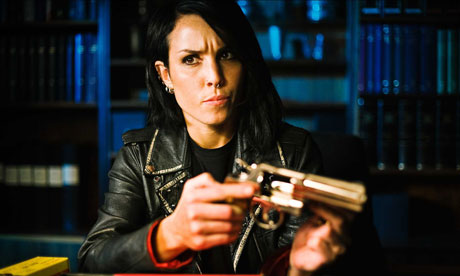
I have a confession to make – I’ve yet to read any of the Millennium trilogy books (although I’ll be remedying that very shortly, I promise!). But recently, on the recommendation of a work friend, I watched the original Swedish films (I haven’t seen the Hollywood remake yet), and I was blown away by Noomi Rapace’s portrayal of Salander. Edgy and violent, Salander shouldn’t be a sympathetic character, and yet as I came to understand why she’s the way she is, I liked her more and more.


What about you? Who are your favourite fictional female characters, and why?

Tuesday, 27 December 2011

Author Interview - Liz Coley

Today, I'd like to give a huge welcome to Liz Coley, one of my fellow Lucky 13 authors whose debut novel, PRETTY GIRL-13, is out from HarperCollins in 2013. Liz has also self-published a YA novel called OUT OF XIBALBA, so I've asked her a bit more about both books and about the differences between the self-publishing and traditional publishing processes.


Hi Liz. Tell us a bit about yourself.


I’m Liz Coley, mother of three teenagers, changing careers mid-life from volunteer extraordinaire/chauffeur to author. It’s going to be crazy interesting.

When did you start writing, and why?


I started writing seriously in 2002, when I wanted to create a sci-fi novel my two boys could enjoy. The Captain’s Kid was born over the next two years during piano lessons and taekwondo classes. It has never sold. I kept writing, though, because I was determined to give it a solid effort, and, I reassured myself, I was setting a great example for my kids of standing up in the face of rejection and plowing ahead with my dreams.


What is your writing process like?


First I have to go grocery shopping on the way home from school drop-off, then prep the vegetables or start a soup simmering. Some dusting or bill paying or sorting things or laundry might enter into it. Then there’s catching a missed episode of Daily/Colbert. Make a latte. Oh bother--it’s almost lunch time. You get the drift. Procrastination often steals the morning, but the afternoon can be a productive rush of writing frantically packed in before carpool.

You have a debut YA novel, PRETTY GIRL-13, coming out from HarperCollins in 2013, but you’ve also self-published a YA novel, OUT OF XIBALBA. What made you decide to self-publish XIBALBA, and what made you decide to pursue a traditional publishing deal for PRETTY GIRL-13?


I have written eight manuscripts by now, all with the goal of traditional publishing. OUT OF XIBALBA was a true labor of love, a story involving a lot of historical research about the Mayans, a sophisticated civilization that fell into ruins in the jungle a millennium ago. I drop a teenaged girl from Ohio alone into that world of human sacrifice, bloody warfare, and palace politics. As a time travel/alternate history/romance/2012 apocalypse story, it wasn’t something hot on the radar for teens, and in fact, many of my readers have been adult men and women. It refuses to be niched, which makes it impossible to sell traditionally. However, I knew I’d regret it forever if XIBALBA languished on my hard drive, so I made the decision to self-publish before the world ends.


Can you tell us a bit more about the process of self-publishing XIBALBA?


Using Createspace for my print platform and Kindle and Smashwords for my ebook editions, I learned so much from self-publishing--lessons that I believe make me a better author for my publishers. Since a self-pub author makes all the decisions, I now have a better appreciation for both cover and internal design--fonts and style decisions and typesetting. I appreciating what it means to be the final copy-editor and proofreader. I get the really important differences between e-pub and print, including use of images and fonts. Most of all, I appreciate the sizable challenges of promotion and distribution. Amazon, Barnes and Noble, Kindle, and Nook all carry OUT OF XIBALBA now, and it is getting nice reviews. I’m working to get it into some libraries and schools. (see LCTeen.com)


And can you tell us a bit more about PRETTY GIRL-13’s journey to publication?


PG13 was my 2009 Nanowrimo novel. I had spent a year thinking about it, the prior summer doing the research, September and October clearing my plate of other projects, and November diving into what was a dark and difficult subject. I delivered the story to my agents in early 2010 and spent half a year in revision with them. They took the manuscript out on submission at the start of 2011, and I signed with HarperCollins in July.


If you could only own one book, what would it be (and why)?


This is too hard. Maybe the Oxford English Dictionary (with the magnifying glass and a really bright light) or maybe a favorite that I have reread to shreds but never get tired of--The Doomsday Book by Connie Willis or Memory by Lois McMaster Bujold.


If you could only own one album, what would it be (and why)?


A recording of Handel’s Messiah, because I could sing along.

Who or what is your biggest inspiration?


In terms of writing, I am always inspired by the stories and interviews I hear on NPR. In terms of how to live your life, I am inspired by my mom.


And finally, what’s next for you?


For Nanowrimo 2011, I am digging into another dark psychological story I hope will please PG13 readers. If PRETTY GIRL-13 is about secrets you can’t even tell yourself, this one is about a guilty secret that has to be told, even if it means losing everything.


Thanks for letting me interview you, Liz! It's been great to have you on the blog and to find out more about your books - they both sound fab!


You can also find out more about Liz here:


Lizcoley.com


LCTeen.com


Phlography.blogspot.com


TheLucky13s.blogspot.com


twitter.com/#!/LizColeyBooks

Wednesday, 30 November 2011

Have You Read… THE IRON JACKAL by Chris Wooding


It was seven feet tall to the shoulder… part human, part animal, part machine. Its short fur was wet and greasy, like something newly born. Its arms were thin and disproportionately long, ending in outsize hands with double-bladed bayonets in place of fingers…

Darian Frey, Captain of the Ketty Jay, is more than familiar with danger. But now his ship is fixed up, he and his crew are celebrities and for once, everything seems to be going their way.

Then they’re offered a job. Frey’s former fiancee Trinica Dracken wants him and his crew to retrieve a relic from Samarla, a desert land where old enemies of Frey still lie in wait for him. But getting the relic to Dracken turns out to be the least of Frey’s problems. Soon, he’s in a race against time, fighting to save his own life as he’s stalked by the terrifying Iron Jackal…

I’ve been a fan of Chris Wooding for a long time. I love his young adult novels, particularly THE STORM THIEF and the BROKEN SKY trilogy, and his adult novels are every bit as good. In fact, THE IRON JACKAL, the third in the Ketty Jay series, has to be one of the most exciting books I’ve read all year.

Starting with a shoot-out in the opening pages, the action never lets up, and the aircraft race scene is absolutely breathtaking. Chris Wooding is also a master at black humour, and there were many moments in the book which made me laugh out loud. The IRON JACKAL’s characters and the relationships and conflicts between them are expertly drawn, the world of the story involved and intricate, yet you never feel like you’re getting bogged down in description or details. I absolutely loved this book and wouldn’t hesitate to recommend it.

For the first two tales of the Ketty Jay, check out the equally excellent RETRIBUTION FALLS and BLACK LUNG CAPTAIN. And you can find out more about all of Chris Wooding’s books on his website here.