Showing posts with label editing. Show all posts

Wednesday, 3 October 2012

In Praise of Editors

…but first, a shout-out for another good cause. Twitter friend and talented artist and graphic designer Angie Shawcroft is helping to organise a Spooktacular Sponsored Stroll at Chatsworth House, Derbyshire on Sunday 28th October to raise money for Cancer Research UK. Follow the link for more info or click on the image to register.


And now down to the serious business of this post.

Editors.

Before I went on my September blogging break, I read this blog post, which left me, well… mystified. One paragraph in particular stood out:  I am really sick of reading about how writers can’t possibly string together so much as a tweet, let alone an entire novel without someone else hanging over their shoulder steering the course. That’s what editors do, after all. Were you fully aware of that? Editors take other people’s material and structure it to suit either their own preconceived notions or the fiscal necessity of the platform they’re editing for.

Um… what?

I am a debut author who is going through the later stages of having her first novel prepared for publication next year. So far, ACID has been worked on by 3 different editors and has gone through 2 major rounds of revisions and a round of copyedits. The whole experience – though it has been a lot of work – has brought me to one conclusion:

Writers need editors.

Perhaps it's because I love revising anyway (much more so than writing first drafts!), but I've found the whole editing process – once the initial post-first edit letter OMG-why-didn't-I-see-all-the-things-that-are-wrong-with-this-book-it-needs-so-much-work-I'm-the-worst-writer-ever shock wore off – both exciting and thoroughly rewarding. The insight the team at RHCP have had into my book is incredible, strengthening it in ways I'd never have thought possible. If the version of ACID that's hitting the shelves next year was the version that originally sold, I'd be cringing at the thought of people reading it (not least because I have a mathematical blind spot, and always get mixed up with my chapter numbers and dates!).

At no point has my original vision for the book been lost. At no point has anyone tried to change the book just to fit in with a preconceived notion or platform. It's my book, made better with the advice and guidance of skilled (and lovely) people who are true experts. Made better in ways that, because as an author I am often too close to my own work to see its flaws, I could never have managed by myself.

No, I don't need an editor hanging over my shoulder steering the course as I write my novels. But I do need editors to help those novels realise their full potential once the first draft is written (and also my beta-reader, and my agent, and… you get the idea). I truly believe that whether you're starting out or an old hand, traditionally- or self-published, the input of others is what helps you shape your work and get better at what you do.

Editors, I salute you.

Wednesday, 20 June 2012

So, What IS a Story?

At school, I remember learning that “a story has a beginning, a middle and an end.” I also remember being told a tale about a frog in a pond who gets out and has a walk around, then has to find his way back. I think it was to do with how stories are circles and the start has to be the same as the end. Or something. Needless to say, I didn’t come out of that lesson feeling particularly enlightened. Maybe some people are lucky enough to be born with an innate sense for storytelling – they don’t need to learn how to do it because they already know.  

All I know is, I’m not one of those people.

Consequently, as a beginning writer, it wasn’t words or ideas that I struggled with, but how to tell a story. And for a writer who was discovering she wanted to write fast paced, plot driven, commercial fiction, that was a HUGE problem. Whenever I'm writing a book, one of my main goals with it is to tell a good story that's well written. If one half of that equation is missing (and it doesn’t matter which half it is), I end up with a broken book. A badly broken book.

The frustrating thing was that, even back then, I knew this. But I couldn’t figure out where I was going wrong. I couldn’t work out why my plots ended up turning in circles or fizzling out altogether; why the crime ‘novel’ I tried to write ran out of steam after 20,000 words or so (which is most definitely not long enough for a novel). I was reading how-to-write books obsessively, and studying novels, trying to figure out the ‘secret’ to storytelling, and failing miserably. I knew the answer was there, but for some reason, I couldn’t quite see it. “You need more conflict,” I remember being told about a short story I’d written. But what did that mean? I hadn’t got a clue.

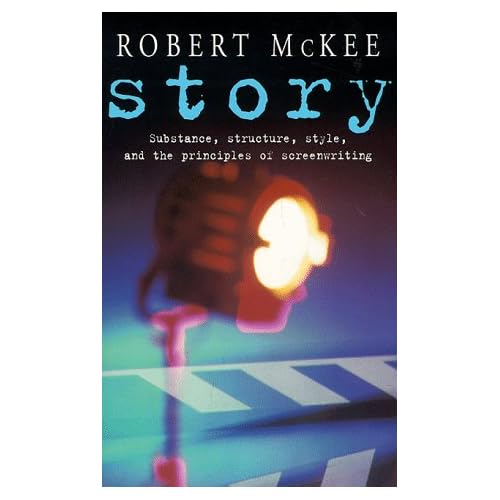
Then I happened across an article in a writers’ magazine about a book called STORY: SUBSTANCE, STRUCTURE, STYLE AND THE PRINCIPLES OF SCREENWRITING by Robert McKee (Methuen, 1999). It sounded interesting, so I borrowed a copy from the library.

This book is made of awesome


It was a revelation. For the first time, here were the mechanics of storytelling laid out explicitly, in diagram form, even. I studied that book from beginning to end, writing out pages of notes, and slowly, over the course of many more stories, began to understand what I needed to do to make my plots work.
So, “a story has a beginning, a middle and an end.” Fair enough. But what function do those three elements actually have? To understand them, it’s necessary to break things down a bit. So let’s give this a YA/kidlit twist and imagine you’re writing a story about a kid who discovers his teachers are zombie vampires…

The beginning: something happens to your Main Character (who shall herein be referred to as the MC) that upsets the balance in his life - he discovers his teachers are zombie vampires. This particular event can also be called (a la McKee) the inciting incident. I like to call it the spark – as in, the event that sparks the story.

This spark propels your MC into a quest to redress the balance in his life, sometimes known as, er, the quest. Basically, it’s their mission to get everything back to normal (they need to find a way to get rid of the vampires).

Only this musn’t happen… not straight away, anyhow. You have to put obstacles in the MC’s way to stop them achieving their mission - aka conflict. Each obstacle must be bigger than the last – for example, first obstacle: the MC needs to make stakes to kill off the vampire teachers, but can’t find any wood; second obstacle: he finds wood and makes the stakes, only to discover all the legends were a lie and vampires can’t be killed by wooden stakes. The number of obstacles depends on the length of your story, and this quest and attempts to overcome the obstacles in their way are what usually make up the middle of the book.

Finally, you reach the biggest obstacle of all - the Crisis. Your MC must take a final action, which, if it fails, there is no return from. This kicks off the story’s Climax, where you show the MC taking that final action - the most exciting point of the story. It can literally be a life or death situation - either your MC has a face-off with the head vampire, and must kill him/her to get rid of the rest of the vampires and save everyone who hasn’t been turned into a vampire themselves. And then you have the resolution where you show what happens next and wrap the book up to whatever extent it needs wrapping up (depending on whether you have a closed or open ending) – AKA the end.

Altogether, this structure is known as the Story Arc. If it was in picture form, it might looks something like this:

© Emma Pass 2012


You don't have to nail this structure in your first draft – I'd say that’s pretty much impossible, in fact, especially if you write the way I do and discover most of your story as you go along. But when I reach the editing stage, understanding how a story actually works is the key to being able to fix problems and make the story I’m trying to tell as strong as possible. Gaining that knowledge has literally unlocked writing for me.

What about you? Which writing resources and advice have you found most useful, and how did they help you?

Wednesday, 4 April 2012

Keep Writing

Firstly! A fantastic new blog for all things UK YA has been launched, courtesy of Keris Stainton, Keren David and Susie Day. Check it out for book recommendations, reviews, guest posts and more.

Secondly! I'm taking part in Crits for Water 2012, which has been set up by the fab Kat Brauer. You can donate to charity:water in return for critiques of your work from authors, agents and editors. I'm not up till June, but the campaign is already running, and there are some amazing critiques to bid for. So go! Bid!

Thirdly! The details of the Derbyshire Literature Festival are up, and you can find out more about mine, Chelsey Flood's and Helen Mort's event on 15th May, where we'll be answering questions about our writing and getting published here. We'll also be reading from our upcoming debuts, so you could get a sneak preview of the opening chapter of ACID!

Fourthly! I have an interview up at fellow Lucky 13 Mindy McGinnis's awesome Writer, Writer, Pants on Fire blog, where you can read more about my writing process, how I got my lovely agent and what it was like to be querying and out on submission.

Which brings me to today's post… 

This time last year, ACID was still being sent out to publishers. I’d already had one book out on sub that hadn’t sold, although it was a near miss. With that book, I hadn’t found the process too stressful, because (and this probably sounds pretty naive) I had an agent! Surely that meant my book would sell… right?

Wrong. Because they don’t. Not always. No-one was to blame – it just wasn’t the right book, and it wasn’t the right time, and eventually, my agent and I agreed we should put the MS to rest.

While that first novel (a contemporary YA) was doing the rounds, I’d already written another, which, for various reasons and after about 5 drafts, got trunked. After that, I started writing ACID. Thankfully, that MS worked out, but when my agent sent it out on submission, I didn’t feel quite so sure about anything any more. Because it doesn’t matter how many people (or books, or blogs) tell you to take the rejections in your stride, to move on, it’s hard – really hard – not to let them knock your confidence. Or it is for me, anyway, as, like most people, I suspect, there’s always that tiny voice in my ear telling me nothing I do is any good. That voice I have to ignore at all costs if I want to get anything written at-all.

This time last year, that voice nearly got the better of me.

With each rejection, I got more miserable and stressed. I was trying to work on a new book, but I wasn’t enjoying it because my confidence had dipped so low. I started to question whether I should be a writer at-all. And I lost sight of the most important thing of all – the writing itself.

Then, right in the middle of all this, I remember asking myself, does my life depend on getting published right now?

And I asked myself, If ACID doesn’t sell, will I stop writing?

The answer to both those questions, of course, was No.

It didn’t make the rejections any less disappointing, and it didn’t quiet my fears that I’d never be a good enough writer to get published, but it did help me gain a sense of perspective about the whole thing. I was putting all my energies into wanting to get published when what I needed to do was put them into my writing. I first started writing (and have kept writing ever since) because I love writing, and I can’t imagine not doing it. I’m also a firm believer that things happen when they’re meant to happen, and reminding myself of that helped too. If I wasn’t meant to get published yet, I wasn’t meant to. Instead, I needed to keep writing, and keep improving.

Easy for you to say, you might think. Your book sold. But it could so easily not have. And if I’d kept get published as my overriding ambition, instead of becoming a better writer, I’m not sure where I’d be right now. Not in a very happy place, that’s for sure.

So if you’re in the query trenches or out on submission right now? Keep writing. Because that’s why you’re there in the first place. And that’s what will get you through… whatever the end result.