Showing posts with label Robert McKee. Show all posts

Wednesday, 20 June 2012

So, What IS a Story?

At school, I remember learning that “a story has a beginning, a middle and an end.” I also remember being told a tale about a frog in a pond who gets out and has a walk around, then has to find his way back. I think it was to do with how stories are circles and the start has to be the same as the end. Or something. Needless to say, I didn’t come out of that lesson feeling particularly enlightened. Maybe some people are lucky enough to be born with an innate sense for storytelling – they don’t need to learn how to do it because they already know.  

All I know is, I’m not one of those people.

Consequently, as a beginning writer, it wasn’t words or ideas that I struggled with, but how to tell a story. And for a writer who was discovering she wanted to write fast paced, plot driven, commercial fiction, that was a HUGE problem. Whenever I'm writing a book, one of my main goals with it is to tell a good story that's well written. If one half of that equation is missing (and it doesn’t matter which half it is), I end up with a broken book. A badly broken book.

The frustrating thing was that, even back then, I knew this. But I couldn’t figure out where I was going wrong. I couldn’t work out why my plots ended up turning in circles or fizzling out altogether; why the crime ‘novel’ I tried to write ran out of steam after 20,000 words or so (which is most definitely not long enough for a novel). I was reading how-to-write books obsessively, and studying novels, trying to figure out the ‘secret’ to storytelling, and failing miserably. I knew the answer was there, but for some reason, I couldn’t quite see it. “You need more conflict,” I remember being told about a short story I’d written. But what did that mean? I hadn’t got a clue.

Then I happened across an article in a writers’ magazine about a book called STORY: SUBSTANCE, STRUCTURE, STYLE AND THE PRINCIPLES OF SCREENWRITING by Robert McKee (Methuen, 1999). It sounded interesting, so I borrowed a copy from the library.
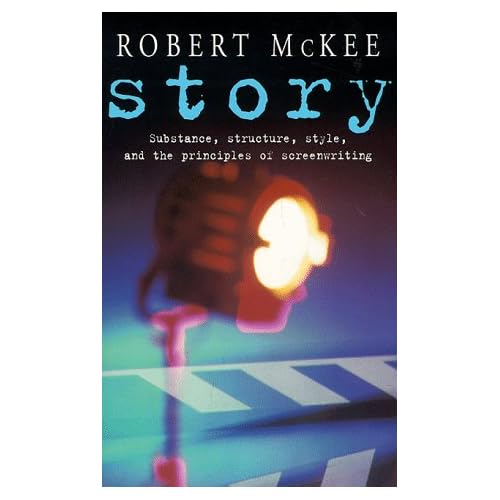
This book is made of awesome


It was a revelation. For the first time, here were the mechanics of storytelling laid out explicitly, in diagram form, even. I studied that book from beginning to end, writing out pages of notes, and slowly, over the course of many more stories, began to understand what I needed to do to make my plots work.
So, “a story has a beginning, a middle and an end.” Fair enough. But what function do those three elements actually have? To understand them, it’s necessary to break things down a bit. So let’s give this a YA/kidlit twist and imagine you’re writing a story about a kid who discovers his teachers are zombie vampires…

The beginning: something happens to your Main Character (who shall herein be referred to as the MC) that upsets the balance in his life - he discovers his teachers are zombie vampires. This particular event can also be called (a la McKee) the inciting incident. I like to call it the spark – as in, the event that sparks the story.

This spark propels your MC into a quest to redress the balance in his life, sometimes known as, er, the quest. Basically, it’s their mission to get everything back to normal (they need to find a way to get rid of the vampires).

Only this musn’t happen… not straight away, anyhow. You have to put obstacles in the MC’s way to stop them achieving their mission - aka conflict. Each obstacle must be bigger than the last – for example, first obstacle: the MC needs to make stakes to kill off the vampire teachers, but can’t find any wood; second obstacle: he finds wood and makes the stakes, only to discover all the legends were a lie and vampires can’t be killed by wooden stakes. The number of obstacles depends on the length of your story, and this quest and attempts to overcome the obstacles in their way are what usually make up the middle of the book.

Finally, you reach the biggest obstacle of all - the Crisis. Your MC must take a final action, which, if it fails, there is no return from. This kicks off the story’s Climax, where you show the MC taking that final action - the most exciting point of the story. It can literally be a life or death situation - either your MC has a face-off with the head vampire, and must kill him/her to get rid of the rest of the vampires and save everyone who hasn’t been turned into a vampire themselves. And then you have the resolution where you show what happens next and wrap the book up to whatever extent it needs wrapping up (depending on whether you have a closed or open ending) – AKA the end.

Altogether, this structure is known as the Story Arc. If it was in picture form, it might looks something like this:

© Emma Pass 2012


You don't have to nail this structure in your first draft – I'd say that’s pretty much impossible, in fact, especially if you write the way I do and discover most of your story as you go along. But when I reach the editing stage, understanding how a story actually works is the key to being able to fix problems and make the story I’m trying to tell as strong as possible. Gaining that knowledge has literally unlocked writing for me.

What about you? Which writing resources and advice have you found most useful, and how did they help you?

Wednesday, 7 March 2012

Reading About Writing

Before ACID sold, I didn’t tell many people I was a writer, never mind a writer who was trying to get published (you can read more about that here). The only people who read my stories were my husband and then my agent. And a combination of my shyness about sharing my work and tight finances meant going on courses was pretty much out of the question.

But I wanted to learn to write better. I needed to learn to write better. So I turned to writing books. While no book can ever provide you with a formula for success – I firmly believe that there is no ‘right’ way to write, only the way that’s right for you – reading about how other people solve their writing dilemmas is a great way to work out how to solve yours. These books are my favourites, the ones that helped and inspired me the most on my journey to becoming a published writer, and that continue to help and inspire me today.


Stephen King - On Writing
(New English Library, 2001)
I’m a huge King fan anyway – I read IT when I was thirteen, and have been hooked ever since – so when this book came out, I snapped it up. If you’re looking for precise instructions on how to query agents or structure your plots, this may not be the book for you, but with generous handfuls of autobiography thrown in, it provides a fascinating insight into the way this celebrated author works.


Sol Stein - Stein On Writing
(St Martin's Griffin, 2000)
This is much more nuts-and-bolts stuff. Sol Stein is an author, poet and playwright, who’s also edited writers like Dylan Thomas, Jack Higgins and W.H Auden. In this book, which he descibes as "…not a book of theory… a book of useable solutions…" he takes you through different techniques to make your writing work. Better than that, he shows you how to make it come to life and grab your readers by the throat. It also covers what he calls the ‘triage’ method for revising, which is one of the most useful ways of revising I’ve ever come across.


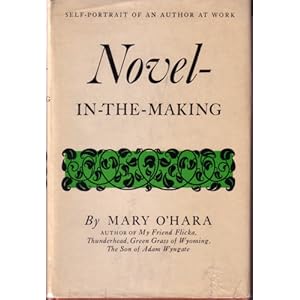
Mary O’Hara - Novel-In-The-Making
(David McKay Company, 1954)

Mary O’Hara is another writer I’ve loved from a young age, ever since I read MY FRIEND FLICKA - still one of my favourite books ever. Novel-In-The-Making, described as a self-portrait of an author at work, deals with the creation of her adult novel, THE SON OF ADAM WYNGATE, and is one of the most fascinating looks at an author’s writing process I’ve ever come across. It reads like a novel itself, and the description of her workstation on pages 106-7, with pigeonholes for “…paper, carbons, finished chapters, discards etc…” is just wonderful


 Robert McKEE - Story: Substance, Structure, Style, and the Principles of Screenwriting
(Methuen, 1999)

For me, this is The Book. The one that quite literally turned my writing around. When I first started writing seriously, I kept coming up against the same problem: my plots either went round in circles, or fizzled out altogether. There was something I just wasn’t getting, but I couldn’t work out what, and I couldn’t find anything or anyone who could tell me. Then, one day, I saw an article in a magazine about McKee’s book. The library where I worked at the time happened to have a copy in, so I borrowed it. It was a revelation. Don’t be mislead by the title - there is very little in this book which relates specifically to screenwriting. Instead, it demystifies what makes a story work. It’s hardcore stuff – I had to take notes as I read it, and it was a good year before what I learnt from it really started to sink in. But it was worth every minute I spent poring over it, trying to understand what McKee was telling me. I re-read STORY at least once a year, and every time I do, I get something new from it.

What about you? Which writing books do you turn to for help and inspiration?

Tuesday, 15 November 2011

First Draft Doubt

As some of my Twitter friends know (because they told me about it - thank you!) ACID was announced in the Bookseller yesterday, along with three other dystopian YA novels by Sangu MandannaLissa Price and Jennifer Bosworth which will be coming out from Random House Children's Books in 2012 and 2013. Their books – THE LOST GIRL, STARTERS and STRUCK – sound amazing and I can't wait to read them! You can see the announcement here: 


http://www.thebookseller.com/news/knowles-signs-dystopian-deals-rhcb.html

And now (ahem), on with today's post…


When I first start a new story, I’m always excited. It’s a shiny new idea, one I’ve thought about for months, even years, and I can’t wait to plunge in and start start that mysterious process of alchemy which brings my plot and characters to life. But as I continue – usually when I get to the end of the first third – uncertainty sets in. And then all my insecurities come flooding in. This is the worst idea ever. I didn’t plan it enough. My characters suck. My writing sucks. I suck.

…You get the idea.

It used to paralyse me. I couldn’t keep going with anything. I’d rip every story up and start over, again and again, until I had to give up on them because I’d completely lost sight of what I was trying to write about in the first place.

Something had to change.

One day, I happened upon a quote from Jacqueline Wilson, where she said that with each book she writes, about halfway in, she starts to doubt whether it’s ever going to work, and that she ‘never write[s] with great confidence.”

Yes, you read that right – Jacqueline Wilson. Former children’s laureate and bestselling, multi-award-winning author of around 90 books. Books which fill almost half a shelf in the library where I work – when they’re there, that is, which isn’t often because they get borrowed so often (she’s one of the top ten borrowed authors in the UK).

I was astonished. Because back then, if you’d asked me who I thought was least likely to have confidence crises in the middle of writing something, I’d have said Jacqueline Wilson.

And it made me think. Apparently, other writers suffered from First Draft Doubt too. Writers who were published, and published many times. So how did they deal with it? How did they get their books finished? Was there a top secret formula which, when applied to wavering plotlines or flagging characters, would bring them round as effectively as a sharp smack in the face (or smelling salts, if violence wasn’t your thing)?

Of course not.

Because there is no secret.

Only this: it’s normal to doubt your first draft. You should doubt your first draft (because that’s what drives you to make it better). And you shouldn’t let that get in the way of you writing it.

That’s not to say if it’s not working that you shouldn’t find out why. These days, I do this by writing letters to myself, starting them “What needs to happen next?” Then I keep writing, trying to switching off my conscious, logical brain and allowing my characters and plot to lead me from my unconscious brain, where the answers have usually been brewing all along.

I also turn to my favourite book about writing and storytelling - STORY: Substance, Structure, Style and the Principles of Screenwriting by Robert McKee. Although it’s not an easy read – I had to take notes the first two times I read it! – I’ve learnt so much from this book. If I’m having a serious plot problem, a combination of dipping into this book and a What Happens Next letter get it back on track.

The most important thing I’ve learnt, though, is that the first draft doesn’t need to be perfect. It can’t be perfect. It’s a sketch, a roughing-out, a shuffling-together of ideas, and if you try to make it perfect, it won’t get done.

Instead, ignore those doubts, accept and note your story’s flaws, and get the damn thing down anyway. Because then you’ve got something to work with. Something to make better. Material for a second draft. And that’s where the real fun begins!

What about you? Is there a particular point in your writing you always lose confidence at? And how do you deal with it when you get there?

Wednesday, 2 November 2011

How YA Saved My (Writing) Life


When I was a kid, I read every book in the children’s section of my local library I could get my hands on – Roald Dahl, Enid Blyton, Judy Blume, Nancy Drew, the Hardy Boys… I loved authors like Anne Pilling and Robert Swindells, too, I was a Point Horror junkie, and I devoured the Sweet Valley High books (well, they had a certain glamour!). I also read each and every one of the Chalet School books, lent to me by a relative. Basically, there wasn’t much I didn’t read. I loved it.

Then I hit my teens. Back then (and it wasn’t that long ago) YA didn’t really exist as a genre – at least, not in the sense it does now. And I don’t remember there being a designated section in our library for books for teens like we have in the library I work in today.

So I skipped straight from kid’s books to adult books – Stephen King, Ben Bova, Michael Crichton. About the same time, I started writing, and as a result, my early ‘novels’ (which I still have, stacked in the top of a wardrobe), have a distinctly hard-boiled flavour as I tried to imitate these authors, both in content and in style. I was thrilled, at fourteen, when my grandmother inadvertently paid me one of the biggest compliments anyone’s ever made about my writing – that I wrote like a forty-year-old man.

Then came the GCSE years, and reading for study, rather than pleasure. And as we analysed the meaning of Scout and Jem’s every word in To Kill a Mockingbird*, and dutifully wrote essays about Macbeth, I began to wonder whether, because, secretly, I still preferred Sci-fi to Shakespeare – despite being told that THIS was great literature! – I was lacking in some way.

So I turned my back on the books I liked to read in favour of the ones I thought I should be reading. Stopped writing the stories I wanted to write in favour of the sort I thought I was supposed to. And pretty quickly, I stopped having fun with them. Just stopped.

Often, I had to force myself to read. The few times I cracked and bought, say, the latest Stephen King, it was a guilty pleasure, one I’d only allow myself every now and then. One strange pattern did emerge, though – the ‘literary’ books I was making myself read nearly always had a young or teenage protagonist. But the significance of this didn’t occur to me then; I knew I felt more of a sense of kinship with these sorts of characters than any other, but I didn’t stop to think about why, or what that might mean for my own writing. In a desperate attempt to revive my fading enthusiasm, I had a go at a story for children, but because I didn’t read children’s books – I didn’t think I was allowed to, somehow (a crazy notion; I realise that now) – it failed, and ended up in the bin.

At the same time, I started to realise that I had no idea how to write a plot that actually worked. I’m not one of those lucky people born with an innate sense for storytelling – I simply couldn’t figure out why the plots in everything I wrote flatlined, or went in circles, or simply went nowhere at-all. Maybe it’s time to give up, a little voice in my head started telling me. Maybe you’re not a writer. Maybe it’s time to try something else.

Then two things happened. I saw a review of a book, STORY: SUBSTANCE, STRUCTURE, STYLE AND THE PRINCIPLES OF SCREENWRITING by Robert McKee, in a magazine. It sounded interesting – the article talked about it as if it could be applied to novel-writing, too – and the library had a copy in, so I borrowed it and found out it does exactly what it says on the tin. I’ll warn you, though, it’s not a book for the fainthearted. I had to read it through twice, taking detailed notes, before I even started to understand what it was trying to tell me. But then it started to click. I started to get it. And started to realise where I’d been going wrong.

At almost exactly the same time, I got the opportunity to go on a weekend course run by the award-winning YA & children’s author Linda Newbery. Better read one of her books, I thought (as shockingly, I never had). So I got myself a copy of THE SHELL HOUSE, which at the time was her latest novel, about two teenage boys separated by almost eight decades but linked by a crumbling mansion, and who are both struggling with issues of identity, faith and sexuality.

It was a revelation. I enjoyed it so much I read it in less than two days. And after the course, which was interesting and fun, I went back to the bookshop and the library for more YA books by other authors. I couldn’t get enough of them.

But still, my brain was slow to catch up. It wasn’t until several months later that something suddenly occurred to me: why not try writing the literary coming-of-age novel I’d been struggling with, on and off, for two years, as a young adult novel?

I remember that moment so clearly. It was an autumn evening, and I was sitting on the sofa in the little rented flat my then-boyfriend (now my husband) and I were living in at the time. I’d been working on another story all day which I was bored to death with. I hated the storyline. I hated the characters. I was constructing it according to McKee’s principles in STORY and it still didn’t work. But I was ploughing on relentlessly with it because I felt I ought to.

The moment the thought of writing YA exploded into my brain (it really was that dramatic) I put the boring story to one side, grabbed a notebook and started scribbling as ideas for this new novel literally tumbled into my head. Everything I’d learnt from STORY (which I’m still learning from – I don’t think I’ll ever stop) collided with the characters and story I’d been trying to piece together, and by that night I had an outline and a first chapter written out.

For the first time ever, I fell in love with my characters, becoming so obsessed with them I wouldn’t have been surprised to see them get on the bus when I was on my way to work. I found myself listening to music that sounded like the story. I was totally and utterly immersed in the world of the story – the first time it had ever happened. It was incredible.

That book was also the first one I ever sent out to agents and publishers, although – quite rightly, because it was terrible – it quickly collected a stack of rejections, and it would take several more novels before ACID was born. But from that moment on, I knew: I was going to write YA. I was going to read YA. And I was going to love it – every single minute of it.

What about you? How did you find your genre? Or are you still searching for it? Whatever stage you’re at, I’d love to hear about it in the comments!

*Ironically, I recently picked up my battered, much doodled-in copy of TKAM and it’s one of the best books I’ve ever read. Go figure!