Wednesday, 28 March 2012

The Results Are In!

I had an incredible response to the survey. 82 of you took part altogether, so thank you, awesome blog readers! I also had LOADS of entries into the giveaway – woo-hoo! – so I’ll announce the winners of that first. Drum roll please…

The winners (picked using random.org) are Peggy Eddleman and Louisa Reid! Congratulations, Peggy and Louisa! I’ll be in touch shortly to find out which prize you’d like.

And now, the survey results!

Question 1:
Writing: 72
Music: 2
Visual Arts/Design: 6
Performing Arts: 2

Question 2:

I love solitude and am happiest and most productive when I’m on my own: 31 (28 writers, 2 visual artists, 1 performing artist)
I like a balance - some solitude, some company: 49 (42 writers, 1 musician, 5 visual artists, 1 performing artist)
I prefer to be round other people most of the time - being on my own drives me crazy! 1 (1 writer)
No answer given: 1

Question 3:   
I spent a lot of time alone; I didn’t feel as if I fitted in at-all: 32 (28 writers, 3 visual artists, 1 performing artist)
I spent some time alone, but had a few close friends who ‘got’ me: 46 (41 writers, 1 musician, 3 visual artists, 1 performing artist)
I had a large group of friends, and didn’t spend much time on my own: 4 (3 writers, 1 visual artist)

Question 4:

Yes: 75 (68 writers, 6 visual artists, 1 performing artist)
No: 7 (4 writers, 1 musician, 1 visual artist, 1 performing artist)

Finally, here are some of the responses I had to the last question: If yes, what effect do you feel they’ve had on your work?

I'm so used to living in my own head and supplying my own "playmates" (characters) that it has become a habit.  I find them much more interesting than most "everyday" people I meet although I take lots of individual pieces from everyone I meet (a gesture, an facial expression or phrase, a way of walking or physical features).
If I had had other children to play with (none) as a child, I might not have developed this habit.  Also difficult for me to choose in 1st question as I also worked in the performing arts - same outcome - I am a good mimic because I got to watch a lot without being involved.

It's natural for me to spend hours with my head in a book - forgetting the outside world on occasion (doesn't go down well with hubby lol) - and thus natural to spend time with my head in *my* book. Used to being with my own thoughts....which of course lead to dialogue, plot, etc. I still have only a few very close friends, one of whom is my co-author. Sharing such a strong connection means we can work together without falling out (much :p).

I write (amongst other topics) about bullying, and the social anxiety that it caused. I'm glad it's no longer a secret and that I've had only supportive comments on my blog.

I often write about people with unresolved pasts or are damaged in some way. I was bullied a lot at school and had no friends, so I created my own little world where books let me escape to. I still live in it from time to time and I'd love to help others create their private escapes too.

Ann Patey:
I honestly don't know what affect being lonely had on my writing but I've felt the odd one out, the outsider for most of my life. That changed overnight when I joined a writers class in my 40s and suddenly felt I'd found kindred spirits.

I feel it's had an influence on my areas of interest without me even being aware of it! I wrote my dissertation on the role of the 'outsider' in Tim Burton's films, everything I have ever written (now that I stop and look back at it!) starts with a character who is for isolated or different in some way. The funny thing is it’s only recently I have noticed this! I think maybe it's because it's the only way I know how to feel, and therefore cannot write from a different perspective? I think if I tried to write about a girl who was the life and soul of the party she would be nothing more than a flat stereotype.
I may have just unearthed a large flaw in my ability as a writer!!!

Definitely had a tough childhood with racism, bullying, etc. I really do think that feeling of being an outsider has influenced my writing because as a kid, books became my best friend. It was an escape from everything, and we all know how reading is the foundation to being a writer!!

Looking back, it's easy to remember the painful parts of growing up -- the heartbreaks and rejections, the loneliness, disappointments, and failures all became formative in so many ways. In hindsight, I'm able to use them as a barometer, a measuring stick for who I am now and how I became this person. I can see my own arc, and I think that helps me to understand both the emotional significance of those early formative experiences (both positive and negative), as well as how those kinds of cumulative moments contribute to the person my character might later become.

'Not fitting in' isn't a recognised medical or psychological condition, but it can cause immense pain and discomfort in a society that wants you to conform. Having said that it has given me insight and empathy which I can draw from for a whole variety of characters. I worry my extrovert characters might not be as 'real' as I'd like them, but from my introverted position I have observed a great deal and can read people pretty well! I can understand my introvert and 'problem' characters much more and they are the ones that are most prominent in my writing! Maybe being an introvert has increased my imagination and ability to tell a story because of the time given to dreaming and imagining?

I write YA, so a lot of what I write about is drawn from my teen years.  I find myself writing about events that happened in my life (especially the small details in my writing).

Sarah Benwell:
I think spending a lot of time (more as a younger kid than as a teen) on the outside and uncomfortable around people taught me to observe keenly, and to empathise with people in difficult situations. And, instead of forcing myself into situations I was unhappy in, I daydreamed, and read, and wrote, and started to learn my craft.

I grew up on a farm with 3 siblings.  My older brother did his own thing, so it was me and the younger two, making up our own games.  I read a lot.  A LOT.  I spent most of my time in my imagination--which is generally not a plus for teen popularity.  But I guess you could call it training for being an author :)

Rebecca Christiansen:
Nostalgia fuels my writing in a lot of ways. I often write characters who are haunted by the places of their past -- not just events or people, but houses, rooms, things they loved. The absence of those things we come to love has been so hard on me in my life, so my characters often end up like this as well.

Angela Young:
I believe my childhood experiences made me a more empathetic person, capable of writing with compassion.  I am an introvert, but like people around me sometimes.  I don't want to join in all the time, I just like to listen.  This quiet listening has garnered me quite the education and given me insight into a lot of things, such as patterns and why people do things or even pretend things.  Childhood experience, and adult understanding of it, drive what I write and often how.

I think I'm drawn to writing characters how are outwardly confident and comfortable but struggle to be happy with themselves.

Amanda Hosch:
I come from a long line of introverted grammar geeks. Seriously, I found letters from my grandmother to my mother with newspaper clips that had been corrected in red ink! At home, it was fine that I made up stories all the time ("can't eat the brown M&M, the orange one would miss her too much on her sea voyage") and had a book permanently glued to my hands. At school, I was that kid reading in the corner of the yard at recess, waiting for the bell to ring. Now, I truly appreciate the odd tangents my mind takes. So, I let it go, and my protagonist has a wild ride in front of her.

I think my outsider feelings have meant that I feel trapped at the age I found most difficult - around 15 - and I feel comfortable writing about characters who are at that age. I'm constantly writing about female friendships going wrong, because mine always seemed to. I don't think I ever looked like an obvious outsider and I was never teased or bullied so sometimes I feel like a fraud - like perhaps I wasn't unusual enough to give myself outsider status. Nevertheless, I did feel that way and frequently still do.

I am very interested in psychology... more interested in WHY characters do what they do than in simply constructing a rollicking good plot (though of course I try to do that too!).

My characters are often shut out from the group, isolated in some way, or loners. It isn't as if my entire childhood was like that, but I had a few acutely painful experiences in my formative years that I draw on frequently in my work. And I spent a lot of time in my head and in my books, making up places that were, in some ways, better than reality. I always liked being alone, but I needed a mix, too--some time with close friends to balance it out. My more extroverted friends just didn't understand WHY someone would want to spend a lot of time alone in her room with her imaginary pals.

I definitely think my childhood reading influenced my work - I loved (and still love) the pen and ink drawings in books like The Worst Witch, The Famous Five and Ballet Shoes, and nowadays I'm producing line drawings of my own. In terms of my social experiences, I was bullied a lot in my teenage years, but instead of changing to fit in I ended up deciding it was better to be alone than to turn myself into something I despised. I think this feeling of independence has carried over into my work nowadays - I love looking at lots of different styles of illustration, but I always remind myself to stay true to my own style and not be overly influenced by the latest trends.

So there you have it. Obviously, us creative types aren't always introverts, but it would seem that, from these results, being a writer, artist, musician or even a performer and being introverted (to various degrees) do often go hand in hand… and can be essential to our work. 

So far from being made to feel it's a bad thing, we should embrace our love of solitude, our need for quiet, and not feel as if we have to make excuses for it. It doesn't mean we're antisocial. It doesn't mean we're weird. It's just how we are. Without introverts, there would surely be fewer books, fewer films and plays and shows, less art, less music… and who wants to live in a world like that? Not me, that's for sure.

Thank you again to everyone who took part - these posts have been so much fun, and it's been fascinating to read everyone else's take on what it's like to feel as if you're 'outside looking in'. I need a lie down after all this number crunching, but I’ll see you again on Friday, when I have a very special post with a very special guest! Can't wait!

Tuesday, 27 March 2012

The survey and giveaway are now closed!

Thank you so much to everyone who entered. I've had over 80 people fill in the survey, which is incredible! So now I need to go away and do maths. Yikes. Expect possibly inaccurate results, plus the winners of the giveaway, here on Wednesday!

In the meantime, here are some cupcakes, because you are all awesome.


Wednesday, 21 March 2012

An Unscientific Scientific Experiment… and a Giveaway!

First of all, I want to say a huge thank you to everyone who read, commented on and tweeted about my blog last week. I was so nervous about posting it that I nearly chickened out, but the response has been amazing, so I’m really glad I didn’t. After I posted it, a friend sent me a fascinating article from the Guardian about introverts and extroverts, which you can find here (along with some interesting comments below from both camps), and fellow YA author and Lucky 13 CJ Flood wrote a brilliant post examining the pressure we’re put under to conform when we’re at school, both by teachers and our peers. You can read it here.

So it seems that it’s incredibly common for creative people to be introverts - necessary, even. But I also had some comments from people wondering if there were any extroverted writers, artists etc out there, and if so, how common this was. I've been wondering about it too, and thought I’d conduct a highly unscientific scientific experiment, in the form of the survey below, to find out.

Please note: This survey is just for fun – there are no ‘right’ answers. I will only be posting the results on my own blog, and if you take part, you will remain completely anonymous. I will not post individual results or quote you in any form unless I have contacted you first to ask for your express permission to do so.  

So, over to you, lovely blog readers! The survey will close at midnight GMT on Monday 26th March.

Edited to add: I'm getting some wonderful results, but have discovered that even if you comment in the last box, the survey results sheet (which only I can see) doesn't tell me who you are. If you don't mind me contacting you to ask if it's okay to quote you, please could you put an email address or your Twitter handle in at the end of your comment - only I can view the results at the moment so you won't be identified. If you don't put your name, I'll assume you wish to stay anonymous and not be quoted. Thank you!

The survey has now closed. Thank you  to everyone who took part!

But that's not all! Today is also my 6-month blogoversary, so to say thank you for all the support everyone has given my blog so far, I'm having a giveaway! To enter, leave your name and some way of contacting you (your Twitter handle, an email address or a link to your blog's contact page) in the comments (the survey results sheet doesn't tell me who you are). The giveaway also closes at midnight GMT on Monday 26th March, after which I’ll use random.org to pick two people to win a prize. Sadly, I don’t have any book swag for ACID yet, but you can choose from either 2 bars of organic chocolate (please state whether you prefer white, milk or dark) or, if chocolate's not your thing, a notebook (please say whether you prefer plain or patterned). The competition’s open internationally, and I’ll announce the winners when I post the survey results on Wednesday 28th March.

Good luck!

Wednesday, 14 March 2012

Outside Looking in?

When I was a kid, in summer, I loved getting up before anyone else – even my dad, who’s a pretty early riser himself – and slipping out of the house to explore the grounds of the environmental studies centre I grew up at. As I got older, I’d go out walking with only the dog for company. I wasn’t completely antisocial; I had a few friends, but school wasn’t a happy place for me – I got bullied a lot – so I was most content when I was at home with my books and my animals, my fields and my woods. I had a sister who was usually willing to be my partner in crime, and I was perfectly happy with my own company, too. I don’t ever remember feeling lonely.

Then I moved up to secondary school, where it seemed, suddenly, that the Most Important Thing In The World™ was to find your way into a group of some sort. And it didn’t take me long to realise I didn’t really fit in with any of the groups at-all. 

The trouble is, when you’re a teenager, fitting in can be everything. The friends I had at school were outsider-y types themselves, but I didn’t even feel as if I had much in common with them. Why was I still happier reading a book than going to parties and hanging round in a group? Why did I still enjoy ‘boring’ stuff like walking through the woods, or sitting on a beach and gazing out to sea?

What was wrong with me?

By the time I reached my late teenage years, I felt shut off, with no idea of who I really was or what I wanted to do (except to write, of course; I honestly believe this is what kept me sane back then). Things finally changed when I went to university and met other people – including the man who’s now my husband – who didn’t think reading books or gazing out to sea was boring at-all.

Still, it’s taken until quite recently for me to feel comfortable in my own skin, and to stop questioning why, as much as I enjoy talking to and meeting up with my friends, I need time by myself, too. What’s helped is the realisation that I need a balance. Too much time alone and I start to feel stale and cut off from reality – and as a result, so does my writing. Conversely, too much time with other people, especially in large groups, just wears me out. I need time with others to stimulate me and draw me out of myself, but time alone to allow my creative well to refill.

And what about my experiences as a kid and teenager? If I could go back, would I change them? Yes and no. No-one deserves to be bullied – it still affects me now, and I know people who had it way, way worse than I ever did. But no matter what happened, I think I would have felt outside of things in some way, because it’s just who I am – and a facet of my personality that, as a writer, I now find incredibly useful. Whatever genre you write in, you need to have the ability to observe and feel empathy for all sorts of people and situations; to find your way under the skins of characters who might be quite different to you. Being on the outside looking in has definitely helped me with that.

And if you prefer reading a novel to hitting the high street? Walking along the edge of a muddy field, watching the rooks rise from the trees, to being packed shoulder to shoulder in a sweaty club?

There’s nothing wrong with that. And there’s nothing wrong with you.

Wednesday, 7 March 2012

Reading About Writing

Before ACID sold, I didn’t tell many people I was a writer, never mind a writer who was trying to get published (you can read more about that here). The only people who read my stories were my husband and then my agent. And a combination of my shyness about sharing my work and tight finances meant going on courses was pretty much out of the question.

But I wanted to learn to write better. I needed to learn to write better. So I turned to writing books. While no book can ever provide you with a formula for success – I firmly believe that there is no ‘right’ way to write, only the way that’s right for you – reading about how other people solve their writing dilemmas is a great way to work out how to solve yours. These books are my favourites, the ones that helped and inspired me the most on my journey to becoming a published writer, and that continue to help and inspire me today.


Stephen King - On Writing
(New English Library, 2001)
I’m a huge King fan anyway – I read IT when I was thirteen, and have been hooked ever since – so when this book came out, I snapped it up. If you’re looking for precise instructions on how to query agents or structure your plots, this may not be the book for you, but with generous handfuls of autobiography thrown in, it provides a fascinating insight into the way this celebrated author works.


Sol Stein - Stein On Writing
(St Martin's Griffin, 2000)
This is much more nuts-and-bolts stuff. Sol Stein is an author, poet and playwright, who’s also edited writers like Dylan Thomas, Jack Higgins and W.H Auden. In this book, which he descibes as "…not a book of theory… a book of useable solutions…" he takes you through different techniques to make your writing work. Better than that, he shows you how to make it come to life and grab your readers by the throat. It also covers what he calls the ‘triage’ method for revising, which is one of the most useful ways of revising I’ve ever come across.


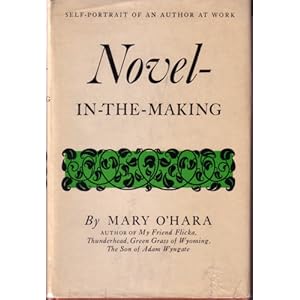
Mary O’Hara - Novel-In-The-Making
(David McKay Company, 1954)

Mary O’Hara is another writer I’ve loved from a young age, ever since I read MY FRIEND FLICKA - still one of my favourite books ever. Novel-In-The-Making, described as a self-portrait of an author at work, deals with the creation of her adult novel, THE SON OF ADAM WYNGATE, and is one of the most fascinating looks at an author’s writing process I’ve ever come across. It reads like a novel itself, and the description of her workstation on pages 106-7, with pigeonholes for “…paper, carbons, finished chapters, discards etc…” is just wonderful


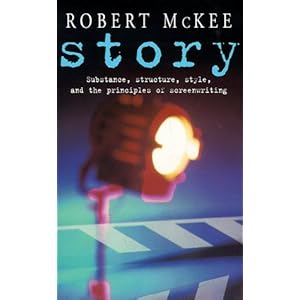
 Robert McKEE - Story: Substance, Structure, Style, and the Principles of Screenwriting
(Methuen, 1999)

For me, this is The Book. The one that quite literally turned my writing around. When I first started writing seriously, I kept coming up against the same problem: my plots either went round in circles, or fizzled out altogether. There was something I just wasn’t getting, but I couldn’t work out what, and I couldn’t find anything or anyone who could tell me. Then, one day, I saw an article in a magazine about McKee’s book. The library where I worked at the time happened to have a copy in, so I borrowed it. It was a revelation. Don’t be mislead by the title - there is very little in this book which relates specifically to screenwriting. Instead, it demystifies what makes a story work. It’s hardcore stuff – I had to take notes as I read it, and it was a good year before what I learnt from it really started to sink in. But it was worth every minute I spent poring over it, trying to understand what McKee was telling me. I re-read STORY at least once a year, and every time I do, I get something new from it.

What about you? Which writing books do you turn to for help and inspiration?

Tuesday, 6 March 2012

What's this? Blogging on a Tuesday?

Yes, I have broken with tradition and blogged on a Tuesday! Not here, though. I'm over at The Lucky 13s, talking about why my characters' names are so important.


See you tomorrow!

Wednesday, 29 February 2012

The Tale of a Serial Story Monogamist

Some writers can start another project as soon as they finish one. Some can even work on more than one at once. I’ve often wished I was one of those writers. But I’m not.

I used to feel guilty for not cheating on my current WIP. Perhaps my desire to be faithful to one story meant I wasn’t a proper writer. Why couldn’t I write poems and a picture book and a MG novel and a YA novel and perhaps an adult novel while I was there, too? And why couldn’t I leap from one project to the next without a thought for the one I was leaving behind, telling it, “It’s not you, it’s me!”, then unfriending it on Facebook and not returning its calls?

Because I just… couldn’t. That’s why.

I get so wrapped up with whatever story I’m writing that there literally isn’t space in my life for another one. My characters become so real that I wouldn’t be surprised to see them getting on the bus when I’m going to work. To have more than one set of them battling for my attention would be exhausting. 

And if I dive into another project straight after finishing the previous one, I end up writing a rebound book. Before I know it, we’re having screaming rows and heading for the inevitable messy breakup. Any writer you ask will recommend having time off in between drafts of a book, as putting your work to one side for a while helps you see it with fresh eyes when you return to it. Over the years (and with several rebound books behind me) I’ve realised I need to do this before starting a new project, too.

I’m in this place right now, as it happens. I’ve just sent my first round of revisions for ACID back to my editor, and Book 2 (which I’d started just before ACID sold) is waiting to be picked up again. I won’t deny that the temptation to dive straight back in is strong – I miss the routine of writing every day; the thrill of all those plot breakthroughs and eureka moments. But I know that, for a couple of weeks at least, I need to step back.

So, while I’m story-single, I’m doing these things instead:

Tackling my TBR pile (yes, this photo is real). A combination of working at library plus my addiction to bookshops and Amazon means I have ALL THE BOOKS. I seriously need to get them read.

Gardening. During winter, I don’t go outside unless I have to (in other words, twice a day, when the Hound gives me That Look). But when spring starts to creep in, I go into a frenzy, digging the veg beds and spending what little money I have left after my book-buying sprees on plants. I’m no Alan Titchmarsh, but there’s something incredibly satisfying about watching things grow (bit like writing a book, really…).

Walking. Once the weather starts to warm up, I love to get out and find new places, like on Sunday when we went to a huge country park: woods carpeted in snowdrops, some incredible, ancient trees, and a seventeenth-century wall with bricks laid in a beautiful herringbone pattern. It was perfect.

And then there’s catching up with friends, excavating the house from beneath multiple layers of Hound hair and dust… None of this means I’m not thinking about my next project, though. I may not actually be working on it, but we’re flirting like crazy – exchanging glances, brushing past one another, exchanging the odd shy word. Soon – very soon – we’ll pluck up the courage to talk to one another, and hopefully it’ll be the start of something beautiful…

In other news: last week, I gave a preview interview about ACID on Presenting Lenore, the blog of YA author Lenore Appelhans, whose debut novel LEVEL TWO is out from Simon and Schuster BYFR in Fall 2012. If you missed it, you can catch it here, along with many other great interviews and reviews of just out or upcoming dystopian books.

I also have a Facebook author page! There’s not a huge amount on it at the moment, but as ACID creeps closer towards publication, I’ll be putting all my book news there. So if you’d like to like me, I’d like that (and you!) very much indeed. :-)

What about you? Are you a story monogamist or a story polygamist? And if you take breaks between projects, what do you do to recharge your writing batteries?

Wednesday, 22 February 2012

Connections and Coincidences

Apologies for being MIA last week. I’ve been finishing up my first round of edits for ACID, and was in the deepest, darkest recesses of the revisions cave with only my survival kit for company. But I’m nearly done now. What will I do with myself when they’re sent off? Hmm. Tackling my TBR pile might be a good idea – if it gets any bigger, it's going to need a risk assessment. I should probably hoover, too…

Anyway, on with today’s post!

I’m fascinated by coincidences – the way seemingly random things can turn out to be connected. Perhaps this is why I’m drawn to writing fiction, as plots are all about patterns and connections (and yes, sometimes you can have coincidences in there too, although you can’t get away with too many).

I say seemingly random, though, because what if they aren’t?

For example, I grew up in an environmental studies centre in the south-east of England. Back in the 18th century, it was a private house, and it was here that the novelist Fanny Burney, described by Virginia Woolf as ‘The mother of English fiction’, met her husband.
Source
 
What about Virginia Woolf herself? Her husband, Leonard, had a sister called Bella (coincidentally, a writer too)… who was married to one of my ancestors.
Source
And then there’s Jane Austen (who can also be connected back to Fanny Burney, as she took the title of Pride and Predjudice from the final pages of Burney’s Cecelia). The environmental studies centre I grew up in was just a short distance from a place called Box Hill, which features in a scene in Austen’s famous novel Emma. Which is why, when I was born, my parents decided to call me Emma.
Source
So, three hugely influential writers, all connected to each other in some way, and all with a connection to me, also a writer (although I’ll get back to you on the influential part). And before I decided I wanted to be an author, I had no idea about any of them. You could call it coincidence, but sometimes, it makes me wonder if becoming a writer was something that was always meant to happen.

What about you? Do you have any connections like this? I’d love to hear about them!

Wednesday, 8 February 2012

Picture This

Whenever I'm planning out a new story, the first thing I do is collect pictures – of people who look a bit like my characters; of places and settings that I think might find their way into the story; of anything that sums up the way the story feels. They help me find my way into its world, then to become immersed in it. For me, writing is also very visual – I see my stories in my head like films, and collecting images that relate to my characters and scenes really help with that.

Until now, those pictures have been printed out on scraps of paper and shoved in a notebook along with the rest of my notes for whatever story they belong to, or collected into a document on the computer and, after the story is written, forgotten about. That was, until the other day, when I got an invite to join Pinterest from Twitter friend and fellow blogger Nettie Thomson (you can check out her wonderful website and blog here). Pinterest is a kind of virtual pinboard, where you can 'pin' pictures you find on the internet and sort them into categories. Of course, I jumped at the chance to sign up. And although I haven't had a lot of time (yet!) to play around with it, you can find the beginnings of my board for ACID here. I'd love to know what you think!

In other news, I'm going to be taking part in my first ever author event as part of the 2012 Derbyshire Literature Festival in May - eek! It's a panel discussion with fellow YA author and Lucky 13 CJ Flood, whose debut novel INFINITE SKY is out from Simon and Schuster in early 2013, and poet Helen Mort, whose debut poetry collection DIVISION STREET is being published by Chatto and Windus, also in 2013. And it will be chaired by recent Derbyshire Poet Laureate and current Writer-In-Residence with Writing East Midlands River Wolton. What great company to be in, eh? I'll post more details as soon as I have them.

Wednesday, 1 February 2012

The Books That Made Me Fall In Love With Words


My mum and dad tell me that when I was very small, I used to come into their room into the small hours of the morning to announce I was bored. So they did what any self-respecting parents driven half-crazy by lack of sleep and middle-of-the-night demands for entertainment would do: they taught me to read.

I don’t remember this. For me, reading’s something that’s always been there, like breathing. What I do remember is the books that were more than just books – the ones that made me fall in love with words.

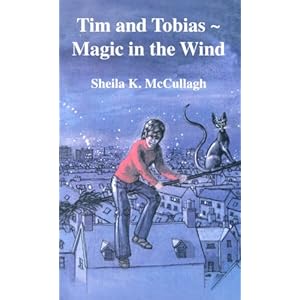
Tim and the Hidden People (series) by Sheila K. McCullagh

I discovered these at school when I was about 5 or 6. While everyone else was listening to the teacher reading about Roger Red Hat (another series by Sheila McCullagh) I’d sneak these off the shelves to catch up with the adventures of Tim, a boy who finds a hidden kingdom, and explores it with the help of a cat called Tobias. Often, I’d get so absorbed, I’d be completely unaware that the teacher had stopped reading and was giving me the Stare of Death™ until she came over and took the book out of my hands.

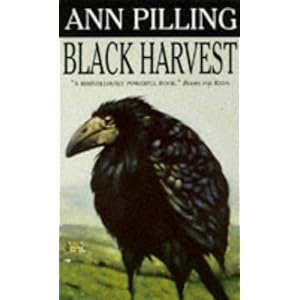
Black Harvest by Ann Pilling

By the time I got to middle school, I’d developed an appetite for ghost stories. One of my favourites was this dark and incredibly creepy book about Colin and Prill, who are dismayed when they find out their dorky cousin Oliver is coming with them on a much-anticipated holiday to Ireland. When they get there, though, Oliver turns out to be the least of their worries. Strange things start to happen – a terrible smell hangs in the air, Prill is haunted by nightmares and their baby sister falls ill. In the end it’s Oliver, the only one who seems unaffected, who discovers a connection to the Great Famine, and must fight to save them all. I remember this being the first book I ever read where, instead of seeing places I already knew in the real world, I saw places that were completely out of my own imagination, conjured up entirely by the words.


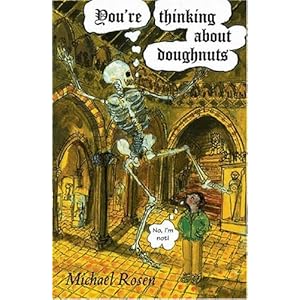
I also loved funny books, and there’s few authors funnier than Michael Rosen. This book is about Frank, who has to wait at the museum one night while his mum, who’s the cleaner there, finishes her shift. The exhibits, which include a talking doughnut-obsessed skeleton, come to life and together, they have all sorts of adventures. I got it through a book club at school and read it until it dropped to pieces.

In honour of the great man himself, I’m going to leave you with a video I discovered yesterday after a friend tweeted about it. The only word for it is… genius.

What about you? Which books made you fall in love with words and reading?