Thursday, 26 July 2012

A Year Ago Today…


…I was waiting on a piece of news which is simultaneously the most exciting and most terrifying thing an agented but unpublished writer can hear.

My book, which had been submitted to Random House Children's Books a couple of months before, was going to aquisitions.

The acquisitions meeting is where The Decision is made about your book. The decision about whether a publisher is actually going to make an offer for it. Even when the commissioning editors and other teams have fallen in love with your novel, it still has to get over this final hurdle. Of course, I was thrilled to have gotten this far – especially as my previous novel hadn't sold – but it was torture, too. Because the thought that my novel could get so close and yet there was still every chance it might be rejected… well, that wasn't the easiest place to be in.

Even worse, at that point, hardly anyone knew I was a writer – let alone a writer with an agent and a book out on submission that was about to go to acquisitions at a major publisher. So I had to go to work that day and pretend everything was normal, even though inside, I was just about ready to explode. I had to smile at people and make conversation when all I wanted to do was to stare at my computer screen, finger hovering over the refresh button on my email inbox.

Not that I wanted any emails. 'If you hear from me today, it's bad news,' my agent had told me. 'If you don't, it's good.' As soon as I finished work, I rushed home, fired up the laptop and logged on. Nothing. I checked again ten minutes later. Nothing. I choked down dinner. Nothing. Saw hubby off to teach his art class. Nothing. Tried to write a bit more of my new novel. Nothing.

And although I'd told myself I wouldn't get too optimistic – that there was still plenty of time for my agent to email me – I began to feel the first glimmerings of hope. Of what if they said yes?

And then, at about quarter past seven, I checked my email one last time, and saw a message from my agent sitting in my inbox.

My heart sank. At arm's length, I opened the email, the same mantra running through my head that I always repeated to myself when I got a rejection: It doesn't matter. Perhaps the next publisher will say yes. Or perhaps it'll be the next book that sells. You'll only fail if you stop writing. And all the while, disappointment sat heavy inside me. My book had got this far, and they still didn't want it.

But it wasn't a rejection. It was a forwarded email from the commissioning editor. The response to my book at the meeting had been positive. They were going to make an offer.

My book was going to get published.

Okay, I admit it, I cried. I may even have screamed and scared The Hound. And I know I re-read that email about a hundred times, not quite daring to believe it was real. But it was. And it was still there the next day. And the next. This was actually happening.

Now, with all the edits and copyedits on ACID done, and the manuscript waiting to go to the typesetter, I can hardly believe that just one year ago, I had no idea if my dream of publication was still books and years away from coming true. That can be the worst thing about trying to get published, I think – the waiting, the not-knowing, the knock-backs which drain your confidence no matter how much you try not to let them.

But if ACID hadn't sold? I'd still be writing, without a doubt. Because you never know when everything's going to change. And a year ago today, that was what happened to me.

Sunday, 22 July 2012

Book Bashing, Back to School (Again!) & Four More Books for 2012

Usually, I chill out on Sundays. Get up late (well, as late as The Hound will let me, which isn't that late, but, y'know), drink coffee, read and generally ignore my to-do list. This time last week, however, found me getting up at stupid o'clock and prising hubby out of bed to drive me over to Matlock, where I'd volunteered to help out at the Big Book Bash. It took a few cups of tea, but I eventually got us both upright with eyes open (sort of), and off we went.

The Big Book Bash, a day of workshops and author talks, has been taking place since 2004 and is aimed at children in care and their foster families. I was there in my day-job capacity and was looking after Annabel Pitcher, author of the amazing MY SISTER LIVES ON THE MANTELPIECE. After meeting my teenage helper Molly I went to help set out the room where Annabel would be giving her talk (which basically entailed trying to figure out how to level a projector with a wonky foot, and hoping the laptop attached to it didn't crash, as I had no idea how to work it). Then it was off to find Annabel and show her to the authors' green room before the Big Book Bash was declared officially open.

Annabel's talk was fantastic - it was so interesting to hear about how she came up for the idea for her book while she was travelling with her husband, and how she started writing it in the middle of the night, and had to tie a sock round his head because she needed the light on, but he was trying to sleep! I can't wait to read her forthcoming novel KETCHUP CLOUDS, which is out at the end of the year.

In the afternoon, I got to sit in on a teenage fiction panel with Annabel and two of my other favourite authors, Phil Earle and Ruth Warburton. The talk was great, and I enjoyed chatting to them afterwards, too (thanks, Phil, for the second-book-nerves reassurance). I came home with a pile of signed books and a huge grin on my face. Events like this are why I love my day job!

So after that, you'd think I'd let myself have an easy day, right? Well, not exactly. Because on Monday I was booked in to do my second ever school visit (you can read more about the first one here). This time it was closer to home, at Brookfields Community School in Chesterfield, where I was doing an author talk and running a workshop for 13 members of their creative writing group. After a warm welcome from head of English Kate Foster, I was taken to the library to meet the group. I started by telling them a bit about how I started writing, and read them the first chapter of ACID. I was pleased with the good reaction it got, as I've read it sooo many times now, I'm starting to wonder how anyone else can possibly find it interesting - I forget that to other people, it's brand new!

After that, we did a warm-up exercise on the theme of 'Lottery'. The scenarios everyone came up with were all so different. One group member even wrote something that had a sci-fi twist, which contained some really powerful imagery.

Once everyone who wanted to had shared their work, we did some work on character building, then had a break for chocolate biscuits (vitally important to the creative process). Finally, I talked about story-writing and got the group to start writing the opening scenes of a story, using the characters they'd created earlier on. Unfortunately there wasn't time for me to hear what they'd written, but the group were loads of fun, and their talent levels were through the roof. A big thank you to Kate and the group for inviting me to talk to them, and I hope I'll be seeing their books on the shelves one day!

Finally, I thought it was about time I added some more books to my 20 Books for 2012 page, so here they are:

SAVING DAISY by Phil Earle
This is Phil's second book and is just as gritty and hard-hitting as his first, BEING BILLY. I remember getting through it in just a few days, desperate to find out what was going to happen next even though I was reading it through my fingers at some points. If you love honest, unflinching contemporary YA fiction, this is definitely the book for you!

MY SISTER LIVES ON THE MANTELPIECE by Annabel Pitcher
Another heart-breaker - you can see why it was shortlisted for the Carnegie medal and has just won the Bransford Boase award. From beginning to end, the story never goes quite where you expect it to, keeping you hanging on until the very last word.

A WITCH IN WINTER by Ruth Warburton
A very different sort of book (and the first in a trilogy - hurrah!), spooky and atmospheric with a paranormal plot. I love that it's set in Cornwall, as I lived there for 3 years, and the descriptions of the towns and landscapes made me feel extremely nostalgic! And I just adore the cover.

POP! by Catherine Bruton
I didn't want to like the heroine of this book at first, but after just a few pages, she'd sucked me in. Set against a backdrop of strikes, and tensions over immigration, this book has one of the quirkiest and most original plots I've ever read. I just loved it!

Annnd… I think that's it. Phew! What have you been up to this week?

Wednesday, 11 July 2012

My New Website!


It's official - I have an author website! Click on the link to take a look - and then come back here and tell me what you think! :)


Monday, 2 July 2012

In Which I Have A Mini Photoshoot, And The Hound Has Other Ideas

You may have noticed I have a fab new photo up on the blog (and Twitter!). It's all thanks to the uber-talented Stacey MacDonald, who blogs over at beautebelle.blogspot.co.uk. Last week we did a mini photoshoot in my back garden, and I'm really happy with the result.

However, someone *coughTheHoundcough* wasn't quite so pleased when he found out what was going on…

Well hey there, Hound fans. Aren't I gawjus?
Huh? What's going on over there?
WHAAAAAAT? You're having a photoshoot? WITHOUT ME??
'Scuse me.

Wait, did you take the lens cap off that thing? Excellent.
How about this? This is a good picture, right?
Actually, over there looks better. Can we go over there?
Now THIS is more like it.
Whaddya think? Is this my best side?
Uh-oh. Drool overload. There's only one thing I can do…
LICK!
 (You wanted your face washing, right?)
Aaah, yeah. Just a little more to the left…

All photos © Stacey MacDonald 2012. Please don't reproduce without permission.

Thursday, 28 June 2012

Interview with Roy Gill, Author of THE DAEMON PARALLEL

Today, I'm welcoming Roy Gill, whose gripping debut novel The Daemon Parallel was published by Floris in March, to the blog!

It was over coffee and biscuits that Grandma Ives offered to return Cameron's father from the dead...

Cameron never came to visit his grandma when his dad was alive -- and he's just found out the reason why. Sent to stay with her after his father's death, Grandma Ives soon reveals their family's extraordinary abilities, and introduces him to the dark side of Edinburgh he never knew existed -- the Daemon Parallel. Cameron is sent on dangerous missions in Edinburgh's daemon underworld to find the ingredients for an ancient spell that will bring his dad back to life. Cameron befriends a werewolf, bargains with a giant bat-like beast, and struggles to escape the clutches of a powerful spider daemon. But will he survive long enough to finish the resurrection spell? And who can he trust in a world where nothing is what it seems?


Hi, Roy, welcome to the blog! Tell us a bit about The Daemon Parallel.

It's about a boy whose father dies, and he's sent to live with his gran. She sits him down with coffee and biscuits, and very calmly offers to bring his dad back from the dead - and that's what starts him off on a very strange and dangerous adventure! There's monsters, plot twists, scares and hopefully some laughs along the way too...

The Daemon Parallel is my first novel, although sometimes it feels like my second or third - it took a while to get it right! It was published earlier this year, and it's still seems a little unreal that people can walk into a bookshop and buy it.

How did you come up with the idea, and what was your journey to publication with the book like?

The original idea came to me in a particularly vivid dream. I dreamt about a boy - Cameron, my central character - staying with his gran in Edinburgh (I'd often done the same when I was small). The city outside her house was both familiar and unfamiliar - like a dark, twisted version of the Edinburgh I knew. He had to go on a dangerous journey through these streets, and when he got back to his grandmother, she didn't seem that pleased to see him! I knew there was something odd about her - she wasn't a traditional granny figure (and not very like my own gran at all).

The dream stayed with me, but it was only when I started asking myself questions about it that I realised it could be the beginnings of a story. I wanted to know what had happened to the city - and finding the answer to that took a while! More importantly, I needed to know what kept Cameron with this strange woman - why did he live with her, and what hold had she over him? That gave me the extraordinary offer - to being his dad back from the dead - that kicked the whole story off! 

I also knew right then how the story ended...

The first chapter was written pretty quickly, and - amazingly - stayed largely the same through all the different drafts, right up to the published book. As for the rest - some of it came more easily than others! 

The journey to publication was quite a long and complicated one... There were probably five years between starting the first draft, and signing the contract to be published (although I wasn't working on Daemon Parallel continuously). During that time there were several opportunities, and several false starts, but I kept plugging away, and hopefully developing and getting better... 

A New Writers' Award from the Scottish Book Trust in 2009/10 put me in touch with a mentor, Lindsey Fraser (who is now also my literary agent). She in turn suggested I submit my manuscript for the Kelpies Prize, which is an annual award for new children's fiction. I was one of three writers shortlisted, at a prize ceremony at last summer's Edinburgh International Book Festival. The prize was a cheque and publication, so tension was running pretty high, I can tell you! Although I wasn't the overall winner, the publishers offered contracts to all three of us. Once I'd finished jumping up and down, I said yes - very quickly!

Did you have to do any research for the book, and if so, what sort?

The book is set in same city I live in, so a certain amount of research involved walking about the streets, thinking about locations I could use, or re-work into a daemonic parallel version! I also read a lot of local history and folklore. When it came to using my research, I would quite shamelessly bend the facts to fit the story if necessary - because the story was the goal, not a travelogue or history lesson. I quite like the idea that the world and characters of the finished book is a mad mixture of the real, the unreal and the re-invented.

How and where do you write? And do you have any superstitions/rituals/lucky charms etc?

I find blank screens don't encourage creativity, so at the start of a story (or chapter or outline or whatever) I like to go for a walk with a notebook, and write things down as they occur to me. I write a fair bit by hand (not very neatly, and with lots of crossing out and arrows) before switching over to the computer. It gets printed out, and scribbled over again, then it's back to the Mac. This goes on for some time!

I used to write directly onto screen, but believe it or not, I found that slower. There's a terrible urge to continuously tinker and improve when you've got the editing facilities in front of you, rather than just writing. It's an odd, ramshackle system, but it's the one that works for me!

I'm largely superstition free - I don't have to have a particular colour pen, or type of notebook or anything. As to ritual, there's usually lots and lots of tea. And I'm probably listening to music, especially if I'm editing. There's a certain St Etienne album that's got me through looming deadlines ever since university, and still works its magic now...

Ok, maybe that's my lucky charm!

If there was one writer, alive or dead, who you could ask anything, who would it be and what would you ask them?

Oh, tricky....

I'd ask John Masefield why he went with that 'it was all a dream' ending to the otherwise amazing 'Box of Delights', and would he mind changing it?

On second thoughts, it seems a bit of a cruel and unusual punishment to whistle-up a long-dead author and compel them to perform a copy-edit, so maybe I should pass...

What is your favourite…

Book?

Archer's Goon by Diana Wynne Jones

Song?

Waverley Steps by Roddy Woomble

Film?

 The Neverending Story

Joke?

Courtesy of the late, great Alan Plater (from his book, Oliver's Travels):
  There was once a farmer who had a horse. His neighbour admired the horse and offered him ten pounds for it. The farmer accepted the offer.
However, before they shook hands on the deal he said to the neighbour, "I should warn you: this horse has one serious weakness: he likes to sit on eggs. So whatever you do, keep him away from eggs."
The neighbour said yes, he would keep the horse away from eggs. So the deal was struck, the neighbour paid the money, and took the horse away.
A week later, the farmer heard loud cries coming from the river. He went down to the river, and there was his neighbor, on the horse, in the middle of the river.
"He won't move," said the neighbour. "We've been here all morning."
"I'm very sorry," said the farmer. "I should have warned you. I told you that he likes to sit on eggs, but I forgot to tell you that he also likes to sit on fish."

And finally, what's next?

Ah ha! That's under discussion... I have two WIPs; a YA fantasy novel and a quirky novel for adults called "The Swimming Pool Rules". And I have a very clear idea of what happens next to the (surviving!) characters from The Daemon Parallel (whoever they might be...). So if enough people want one, there may one day be a sequel...

Thank you, Roy! I'd love to read a sequel, so fingers crossed…

Roy was born in Edinburgh, and grew up in Kirkintilloch and Kirkcaldy. He's performed his writing at many venues, including Aye Write!, On the Rocks and the Edinburgh International Book Festival. The Daemon Parallel is his first novel - it was shortlisted for the 2011 Kelpies Prize, and was published earlier this year. 

You can find him on Twitter (@roy_gill) and on his website.
And you can read an extract of the Daemon Parallel here.

The Daemon Parallel is currently Book of the Month on the Scottish Book Trust website, and if you're quick you can enter a competition to win a copy! Click here for the link.

Wednesday, 27 June 2012

Fairy Dust

After I posted So, What IS a Story? last week, where I attempted to break down the type of story told in fast-paced commercial fiction into its components, one of the commenters quite rightly pointed out that I'd forgotten the most important ingredient of all - the sprinkle of fairy dust.

If a story is the engine of a book, then the Inciting Incident, the quest, the obstacles you place in your main character's way to stop them acheiving their goal are the parts of that engine – the pistons, bearings, pins and cranks. Essential, if a little mundane.

But fairy dust? Fairy dust is the fuel that makes it all work.

It's that surge of excitement when a new idea blossoms in your mind, seemingly out of nowhere. It's that moment when you get a sentence down and it says exactly what you meant it to say. It's the shape of your words in your head and on your tongue, as scenes you've dreamt about for days, weeks, months, years come to life. That fizzing in your fingertips as ideas pour out of them faster than you can type or write.

It's the moment someone gets on the bus you're riding to work and they ARE your main character, or you hear a song and know instantly it was written for the story you're trying to tell. And it's that feeling you carry around with you for days after someone reads the pages you've given them, trying to hide the fact that you just handed them your soul, and tells you you can do this, carry on.

But it's more than that, even.

At first, trying to fit the principles of storytelling to your work can seem dull and uninspiring. It certainly did to me.  I was outlining stories which adhered exactly to the structure in the diagram in last week's post… and they were so boring, they never got written.

But then I discovered YA. I discovered stories and characters I could connect with, and now, instead of trying to come up with plots that fitted a particular structure, I was coming up with ideas I really cared about, and learning how to use that structure to turn them into stories that actually worked. And that excitement, that magic is still with me now.

So more than anything, fairy dust is this: telling the stories that come from our hearts.

Want Me To Critique The First 1250 Words Of Your MG or YA Novel?

Pledging is now closed. Thank you to everyone who entered and congratulations to the winners, Akossiwa, Jean and Carolyn!

And want to raise money for a FANTASTIC cause – helping charity:water bring clean, safe drinking water to people in developing countries?

Then head on over to the beyond awesome Kat Brauer's Crits for Water, where Kit Grindstaff and I are offering critiques in return for donations to charity:water! Kit is a fellow Lucky 13 (and Brit!), whose debut MG novel THE FLAME IN THE MIST is out next year, and pledging is open on our critiques for the next 3 days. Good luck!


Wednesday, 20 June 2012

So, What IS a Story?

At school, I remember learning that “a story has a beginning, a middle and an end.” I also remember being told a tale about a frog in a pond who gets out and has a walk around, then has to find his way back. I think it was to do with how stories are circles and the start has to be the same as the end. Or something. Needless to say, I didn’t come out of that lesson feeling particularly enlightened. Maybe some people are lucky enough to be born with an innate sense for storytelling – they don’t need to learn how to do it because they already know.  

All I know is, I’m not one of those people.

Consequently, as a beginning writer, it wasn’t words or ideas that I struggled with, but how to tell a story. And for a writer who was discovering she wanted to write fast paced, plot driven, commercial fiction, that was a HUGE problem. Whenever I'm writing a book, one of my main goals with it is to tell a good story that's well written. If one half of that equation is missing (and it doesn’t matter which half it is), I end up with a broken book. A badly broken book.

The frustrating thing was that, even back then, I knew this. But I couldn’t figure out where I was going wrong. I couldn’t work out why my plots ended up turning in circles or fizzling out altogether; why the crime ‘novel’ I tried to write ran out of steam after 20,000 words or so (which is most definitely not long enough for a novel). I was reading how-to-write books obsessively, and studying novels, trying to figure out the ‘secret’ to storytelling, and failing miserably. I knew the answer was there, but for some reason, I couldn’t quite see it. “You need more conflict,” I remember being told about a short story I’d written. But what did that mean? I hadn’t got a clue.

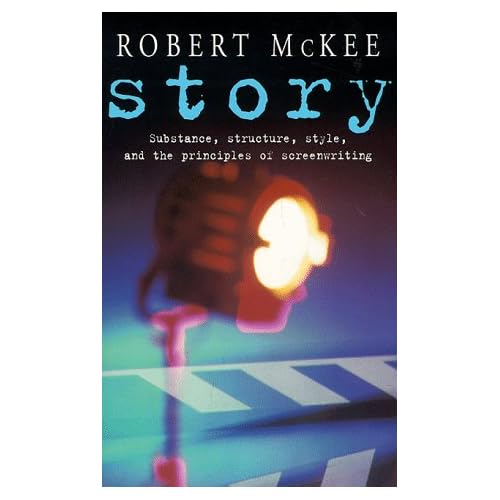
Then I happened across an article in a writers’ magazine about a book called STORY: SUBSTANCE, STRUCTURE, STYLE AND THE PRINCIPLES OF SCREENWRITING by Robert McKee (Methuen, 1999). It sounded interesting, so I borrowed a copy from the library.

This book is made of awesome


It was a revelation. For the first time, here were the mechanics of storytelling laid out explicitly, in diagram form, even. I studied that book from beginning to end, writing out pages of notes, and slowly, over the course of many more stories, began to understand what I needed to do to make my plots work.
So, “a story has a beginning, a middle and an end.” Fair enough. But what function do those three elements actually have? To understand them, it’s necessary to break things down a bit. So let’s give this a YA/kidlit twist and imagine you’re writing a story about a kid who discovers his teachers are zombie vampires…

The beginning: something happens to your Main Character (who shall herein be referred to as the MC) that upsets the balance in his life - he discovers his teachers are zombie vampires. This particular event can also be called (a la McKee) the inciting incident. I like to call it the spark – as in, the event that sparks the story.

This spark propels your MC into a quest to redress the balance in his life, sometimes known as, er, the quest. Basically, it’s their mission to get everything back to normal (they need to find a way to get rid of the vampires).

Only this musn’t happen… not straight away, anyhow. You have to put obstacles in the MC’s way to stop them achieving their mission - aka conflict. Each obstacle must be bigger than the last – for example, first obstacle: the MC needs to make stakes to kill off the vampire teachers, but can’t find any wood; second obstacle: he finds wood and makes the stakes, only to discover all the legends were a lie and vampires can’t be killed by wooden stakes. The number of obstacles depends on the length of your story, and this quest and attempts to overcome the obstacles in their way are what usually make up the middle of the book.

Finally, you reach the biggest obstacle of all - the Crisis. Your MC must take a final action, which, if it fails, there is no return from. This kicks off the story’s Climax, where you show the MC taking that final action - the most exciting point of the story. It can literally be a life or death situation - either your MC has a face-off with the head vampire, and must kill him/her to get rid of the rest of the vampires and save everyone who hasn’t been turned into a vampire themselves. And then you have the resolution where you show what happens next and wrap the book up to whatever extent it needs wrapping up (depending on whether you have a closed or open ending) – AKA the end.

Altogether, this structure is known as the Story Arc. If it was in picture form, it might looks something like this:

© Emma Pass 2012


You don't have to nail this structure in your first draft – I'd say that’s pretty much impossible, in fact, especially if you write the way I do and discover most of your story as you go along. But when I reach the editing stage, understanding how a story actually works is the key to being able to fix problems and make the story I’m trying to tell as strong as possible. Gaining that knowledge has literally unlocked writing for me.

What about you? Which writing resources and advice have you found most useful, and how did they help you?

Friday, 15 June 2012

Happy Birthday Bookstart!

It's the 20th anniversary of Bookstart, the first book-gifting programme in the world, which was launched in 1992. Part of Booktrust, it offers free books to all children during their first year and between the ages of 3-4, usually via health visitors and nurseries. They also run the Bookstart Bear Club online and in libraries (including the one where I work) to encourage young children to read. To help secure future funding, they're asking people to pledge to share 20 books in 2012. Many celebrities are taking part and if you want to join in, you can view the pledge wall and make your own pledge here.

As it says on the Book trust site, there's many ways you can share books - reading them to your own kids (or in my case, The Hound, although he does tend to doze off…), recommending books to friends in person or on line, joining a reading group, taking part in book swaps or posting reviews online. As a writer, encouraging reading (and more importantly a love of reading) is something that's very close to my heart, so I've made my pledge, and I'm going to share my books via this blog throughout the rest of this year. They won't all be books for young children but they will be children's or YA.

So here are my first three books! (I'm cheating slightly, as they're a trilogy, but they're some of my favourite books EVER so I just have to include them.)
  1. Northern Lights by Philip Pullman
  2. The Subtle Knife by Philip Pullman
  3. The Amber Spyglass by Philip Pullman
So, why the His Dark Materials triology? Because every time I re-read them, I get something new out of them. They're exciting, beautifully written, intelligent and thought-provoking, and I can highly recommend them!

In other news…
The copyedits for ACID are done! Woo-hoo! That means I'll be returning to my WIP, which I'm having lots of fun with despite its messy first-draft-ness. And happy book birthday to my dad, whose book Insect Photography - Art & Techniques came out on Wednesday (you can read a bit more about it in last week's post here). Hurrah!

Tuesday, 5 June 2012

Miscellaneous Cool Stuff!

Sooo, I'm still deep in copyedits (notice I didn't say 'copyedit hell', though, because weirdly… I'm enjoying them - yes, I know I'm strange), which means no time for a proper post again. And the Hound has gone on strike, as apparently I didn't pay him enough for his post last week.

Le sigh.

Anyhow, not to worry, because I have some cool stuff to share. Firstly, I'm not going to be the first person in my family to get published! My dad, an extremely talented insect and plant photographer, a Fellow of the Royal Photographic Society and chairman of the RPS Nature Group, has a book out on 15th June from Crowood Press. It's called INSECT PHOTOGRAPHY - ART AND TECHNIQUES, and is aimed at both amateur and professional photographers. He's wanted to get a photography book published for a long time, and I am so thrilled for him! You can order the book directly from Crowood here or find it on Amazon here.

Secondly, Alexander Gordon Smith came to run a horror-writing workshop for a young writers' group I've been helping out with at work. He was brilliant, and the group had a wonderful time, so a huge thank you to him! If you haven't read his FURNACE series yet, I can highly recommend them, and I can't wait to read his latest novel THE FURY, which sounds absolutely terrifying!

Finally, if you missed it on Monday, check out ACID's playlist (and a sneaky look at the theme tune to my WIP!) over at The Lucky 13s.

See you on the other side!